Skip to content

Health information

Colorectal Cancer Screening

Endoscopy · 2 min

FOBT, colonoscopy and who should discuss screening.

Two tests, two different jobs

Screening means looking for colorectal cancer, or the polyps that can lead to it, in people who have no symptoms. A stool test — the faecal occult blood test (FOBT) or the faecal immunochemical test (FIT) — looks for tiny amounts of blood that cannot be seen with the naked eye, and a colonoscopy looks directly at the bowel lining and can remove many polyps at the same time.
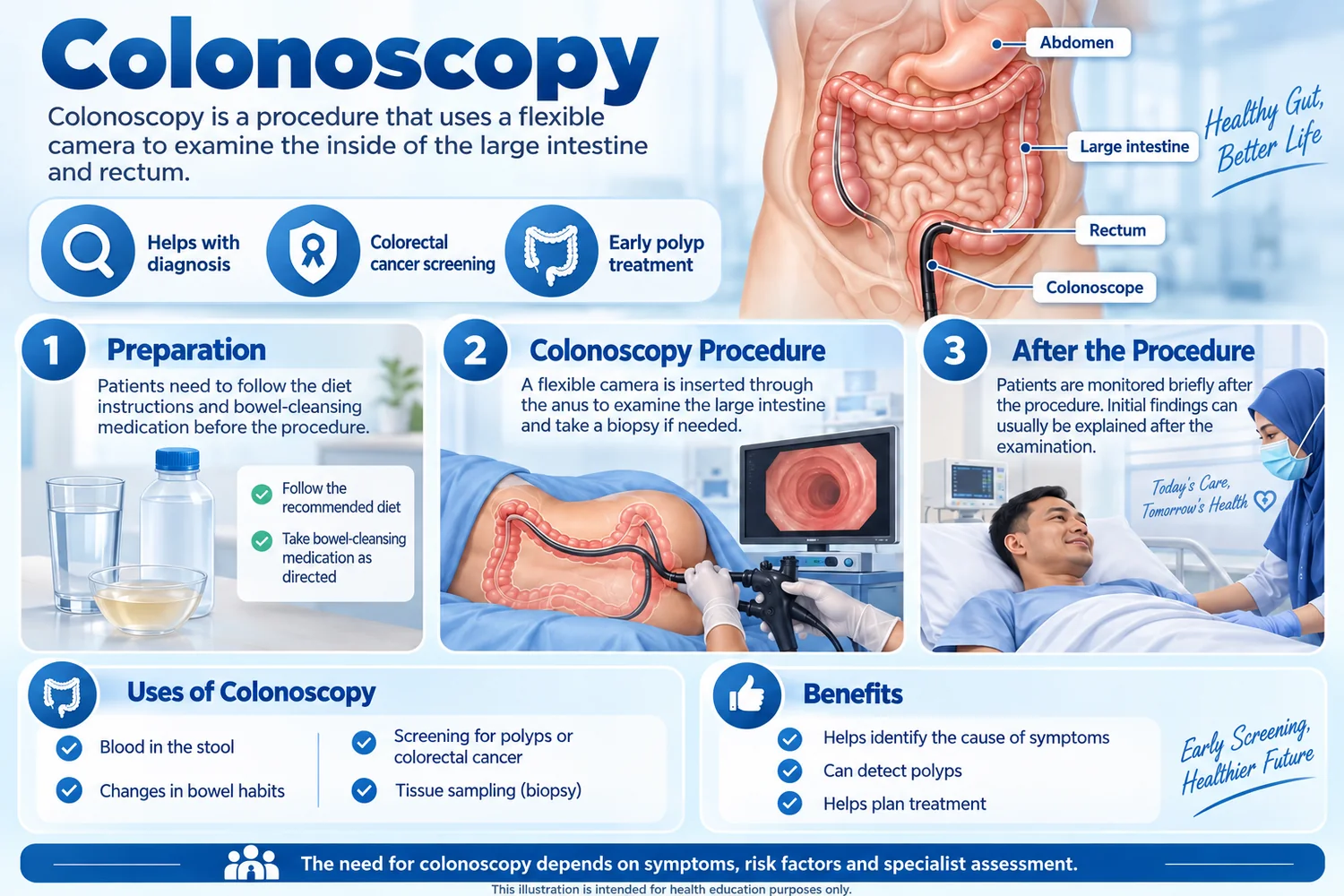
Infographic of colonoscopy, showing a flexible camera examining the large bowel.

In Malaysia, immunochemical faecal occult blood test (iFOBT) screening is offered to asymptomatic people at average risk aged 50 to 75. The repeat-test interval follows the screening programme guidance and your doctor’s assessment. A positive result requires a colonoscopy for further investigation. People at higher risk or with symptoms need a different assessment and investigation plan.

Does a positive FIT or FOBT mean cancer?
No. A positive stool blood test does not diagnose cancer. It means blood has been detected and needs follow-up. Colonoscopy is usually recommended to investigate the cause, taking your health and circumstances into account.

Can polyps be removed during colonoscopy?
Many small polyps can be removed during the procedure, depending on their size and characteristics.

If your symptoms persist or you are unsure of the cause, arrange an assessment.

Colonoscopy uses a flexible tube with a camera to examine the inside of the large bowel. It is used to investigate symptoms, detect polyps, take biopsies and support colorectal cancer screening.

When should you be assessed?

  • Blood in the stool or rectal bleeding
  • Persistent changes in bowel habits
  • Iron-deficiency anaemia without a clear cause
  • A positive stool blood test (FIT or FOBT)
  • A history of colorectal polyps or cancer
  • Screening based on age and risk

Health information

Patient Education

Read health information
  • Blood in the Stool: Haemorrhoids or Cancer?

    Why blood colour alone is not enough to determine the cause.

    Colorectal & perianal

    Read More
  • Colorectal Cancer Can Develop Without Symptoms

    The importance of screening and understanding risk factors.

    Colorectal & perianal

    Read More
  • Do Haemorrhoids Need Surgery?

    When conservative treatment may be enough and when a procedure is considered.

    Colorectal & perianal

    Read More
  • Haemorrhoid Grades

    A simple explanation of Grades I to IV.

    Colorectal & perianal

    Read More

Book an Appointment

If your symptoms persist or you are unsure of the cause, arrange an assessment.