Skip to content

Health information

Gallstones

Abdominal & gallbladder · 1 min

When gallstones may require surgery.

When gallstones become a problem

Many gallstones cause no symptoms at all. Problems begin when a stone blocks the flow of bile: that is when pain appears, and sometimes a complication develops.
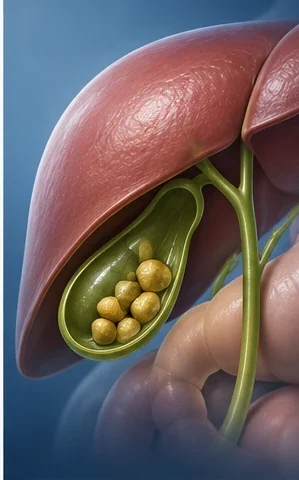
Illustration of the gallbladder and bile ducts containing gallstones.

Seek emergency care immediately if

  • Fever occurs with abdominal pain
  • The skin or eyes become yellow
  • Severe pain does not settle
  • Vomiting is persistent

Assessment usually means a medical examination, an abdominal ultrasound and blood tests, with MRCP, a CT scan or other tests if complications are suspected.

If your symptoms persist or you are unsure of the cause, arrange an assessment.

Gallstones form inside the gallbladder. Some do not cause symptoms, but symptomatic stones can lead to episodes of pain, gallbladder inflammation, jaundice or pancreatitis.

When should you be assessed?

  • Severe pain in the right upper abdomen
  • Pain that may occur after meals, particularly fatty meals
  • Pain radiating to the back or right shoulder
  • Nausea or vomiting
  • Recurrent attacks of pain

Treatment Options

For gallbladder stones that cause symptoms, the usual definitive treatment is removal of the gallbladder (cholecystectomy), most commonly using laparoscopic surgery. The timing and type of treatment depend on any complications and your overall health. Gallbladder stones that cause no symptoms do not usually need surgery. Stones in the bile duct may need removal, often using a procedure called ERCP.

Read More: Gallstones

Health information

Patient Education

Read health information
  • Blood in the Stool: Haemorrhoids or Cancer?

    Why blood colour alone is not enough to determine the cause.

    Colorectal & perianal

    Read More
  • Colorectal Cancer Can Develop Without Symptoms

    The importance of screening and understanding risk factors.

    Colorectal & perianal

    Read More
  • Do Haemorrhoids Need Surgery?

    When conservative treatment may be enough and when a procedure is considered.

    Colorectal & perianal

    Read More
  • Haemorrhoid Grades

    A simple explanation of Grades I to IV.

    Colorectal & perianal

    Read More

Book an Appointment

If your symptoms persist or you are unsure of the cause, arrange an assessment.